Diberdayakan oleh Blogger.
RSS

15 Composer Greatest Throughout History

15 Composer Greatest Throughout History

1. Johann Sebastian Bach


Johann Sebastian Bach (born in Eisenach, Germany, March 21, 1685 - died July 28, 1750 at age 65 years) was a German composer. He composed music for musical instrument organ, harpsichord and clavichord, and also for the orchestra. His most famous is the Brandenburg concertos.
The musicologist Bach divides the whole composition in five days, each composition shows a fairly specific stylistic differences when compared to each other in construction. What makes Bach's music style is different from the others is that all the songs he made a good song Jesu Joy of Man's desiring or songs made ​​mostly addressed to God.

  • Digg
  • Del.icio.us
  • StumbleUpon
  • Reddit
  • RSS

Orchestra

Orchesthra

An orchestra is a sizable instrumental ensemble that contains sections of string, brass, woodwind, and percussion instruments. The term orchestra derives from the Greek ορχήστρα, the name for the area in front of an ancient Greek stage reserved for the Greek chorus. The orchestra grew by accretion throughout the eighteenth and 19th centuries, but changed very little in composition during the course of the 20th century.
A smaller-sized orchestra for this time period (of about fifty players or fewer) is called a chamber orchestra. A full-size orchestra (about 100 players) may sometimes be called a "symphony orchestra" or "philharmonic orchestra"; these modifiers do not necessarily indicate any strict difference in either the instrumental constitution or role of the orchestra, but can be useful to distinguish different ensembles based in the same city (for instance, the London Symphony Orchestra and the London Philharmonic Orchestra). A symphony orchestra will usually have over eighty musicians on its roster, in some cases over a hundred, but the actual number of musicians employed in a particular performance may vary according to the work being played and the size of the venue. A leading chamber orchestra might employ as many as fifty musicians; some are much smaller than that.

  • Digg
  • Del.icio.us
  • StumbleUpon
  • Reddit
  • RSS

Cello

Cello

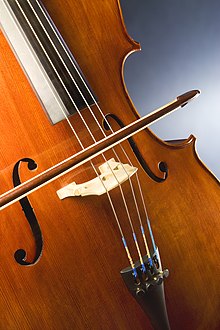
The cello (plural cellos or celli) is a bowed string instrument with four strings tuned in perfect fifths. It is a member of the violin family of musical instruments, which also includes the violin, viola and the contrabass.
The word derives from the Italian 'violoncello'. The word derives ultimately from vitula, meaning a stringed instrument. A person who plays a cello is called a cellist. The cello is used as a solo instrument, in chamber music, in a string orchestra and as a member of the string sectionof an orchestra. It is the second largest bowed string instrument in the modern symphony orchestra, the double bass being the largest.
Cellos were derived from other mid-to-large sized bowed instruments in the 16th century, such as the viola da gamba, and the generally smaller and squarer viola da braccio, and such instruments were made by members of the Amati family of luthiers. The invention of wire-wrapped strings in Bologna gave the cello greater versatility. By the 18th century the cello had largely replaced other mid-sized bowed instruments.

  • Digg
  • Del.icio.us
  • StumbleUpon
  • Reddit
  • RSS

Violin


Violin


The violin is a string instrument, usually with four strings tuned in perfect fifths. It is the smallest, highest-pitched member of the violin familyof string instruments, which includes the viola and cello.
The violin is sometimes informally called a fiddle, regardless of the type of music played on it. The word violin comes from the Middle Latin word vitula, meaning stringed instrument; this word is also believed to be the source of the Germanic "fiddle". The violin, while it has ancient origins, acquired most of its modern characteristics in 16th-century Italy, with some further modifications occurring in the 18th century. Violinists and collectors particularly prize the instruments made by the Gasparo da Salo, Giovanni Paolo Maggini, Stradivari,Guarneri and Amati families from the 16th to the 18th century in Brescia and Cremona and by Jacob Stainer in Austria. Great numbers of instruments have come from the hands of "lesser" makers, as well as still greater numbers of mass-produced commercial "trade violins" coming from cottage industries in places such as Saxony, Bohemia, and Mirecourt. Many of these trade instruments were formerly sold by Sears, Roebuck and Co. and other mass merchandisers.

  • Digg
  • Del.icio.us
  • StumbleUpon
  • Reddit
  • RSS